Asphalt vs Concrete Driveway in Georgia: Which One Fits Your Property?
Short answer first. Asphalt costs less per square foot installed, and you drive on it in days. Concrete carries a longer published life and asks for less routine upkeep. One 2026 national cost guide puts installed asphalt at $7 to $15 a square foot. It puts concrete at $8 to $20. Another guide puts asphalt at $3 to $5 and concrete at $5 to $7.
The guides disagree on the dollars. They agree on the direction: concrete lands higher per square foot and lasts longer. We pave asphalt. We are not a concrete contractor. So here is the fair version, with the places concrete wins said out loud.
Which driveway should you pick in Georgia?
Pick concrete for a short drive at the house when you want the longest published life or a decorative finish. National cost guides put a concrete driveway at 30 to 40 years. The National Association of Home Builders study of home component life lists an asphalt driveway at 15 to 20 years. The Asphalt Institute’s driveway brief puts a well built driveway at up to 20 years.
Pick asphalt driveway paving when the square footage is large, or the drive is long or steep. Asphalt also comes back into use in days rather than weeks. It patches and resurfaces at a lower cost than a cracked slab. On 600 square feet that gap is small money. On 6,000 square feet it is the whole decision.
How do asphalt and concrete compare side by side?
| What you are comparing | Asphalt | Concrete |
|---|---|---|
| Installed cost per square foot | $7 to $15 in one 2026 guide, $3 to $5 in another | $8 to $20 in the same guide, $5 to $7 in the other |
| Published life | 15 to 20 years | 30 to 40 years |
| Drive on it after | 1 to 3 days | 7 days for a car, 28 days for an RV or a truck |
| Routine upkeep | Sealer every 2 to 5 years | Listed as minimal by the cost guides |
| Repair pricing | $1 to $3 a linear foot on cracks, $2 to $5 a square foot on areas | $3 to $25 a square foot |
| Surface in a July sun | Dark, absorbs more of it | Lighter, reflects more of it |
| How it is built | Layers of hot mix over a compacted stone base | A jointed slab poured on grade |
The cost, cure and repair figures come from 2026 national cost guides. The life figures come from those guides plus the home builders study. The sealing interval is the Asphalt Institute’s. It puts a driveway or a low traffic lot at roughly 2 to 5 years between coats. For the dollars on asphalt here at home, read what an asphalt driveway costs in Georgia.
What do red clay, heat and rain do to a driveway here?
Water decides more than the material does. The National Asphalt Pavement Association tells homeowners that standing water is the leading cause of driveway failure. NOAA’s 1991 to 2020 normals put Cartersville at about 48 inches of rain a year.
Red clay gets blamed for cracked driveways. The USDA soil record for Cecil, the red clay of the Georgia Piedmont, rates its shrink-swell potential as low. So it is not the clay swelling and lifting the surface. It is that saturated clay loses bearing and ruts under a load.
On Georgia clay the base decides how long the surface lasts. The Asphalt Institute’s driveway brief calls for a smooth subgrade with weak spots cut out and replaced. It puts 6 to 8 inches of crushed aggregate under the asphalt. A poured slab sits on the same wet clay and needs the same grading work under it.
Heat is a real point for concrete. NOAA puts Cartersville at about 55 days a year at or above 90 degrees. The EPA says conventional pavement reaches peak summer surface temperatures of 120 to 150 degrees. Reflectance drives how hot a surface runs. Asphalt sits at the dark end of the EPA’s 5 to 40 percent reflectance range for pavement. A lighter concrete drive runs cooler underfoot.
Freeze and thaw is mild here. NOAA puts Cartersville at about 67 nights a year at or below freezing. That is enough to work an open crack wider over a winter. It is not enough to decide the material for you.
One more point on concrete, in its own industry’s words. The National Ready Mixed Concrete Association says cracks in concrete cannot be prevented entirely. Joints are pre-planned cracks, spaced about 10 feet apart on a 4 inch slab. Asphalt has no joints. Where it does crack, the fix is filling and sealcoating. Wider wear takes a new layer of hot mix over the old surface.
Why does square footage decide it on a long driveway?
The gap between the two materials is a per square foot gap, so length multiplies it. GDOT’s driveway rules put a residential driveway at a state route at 14 to 16 feet wide. Call a rural drive 12 feet wide and 500 feet long. That is 6,000 square feet, and a two dollar a square foot difference is $12,000 on that one driveway.
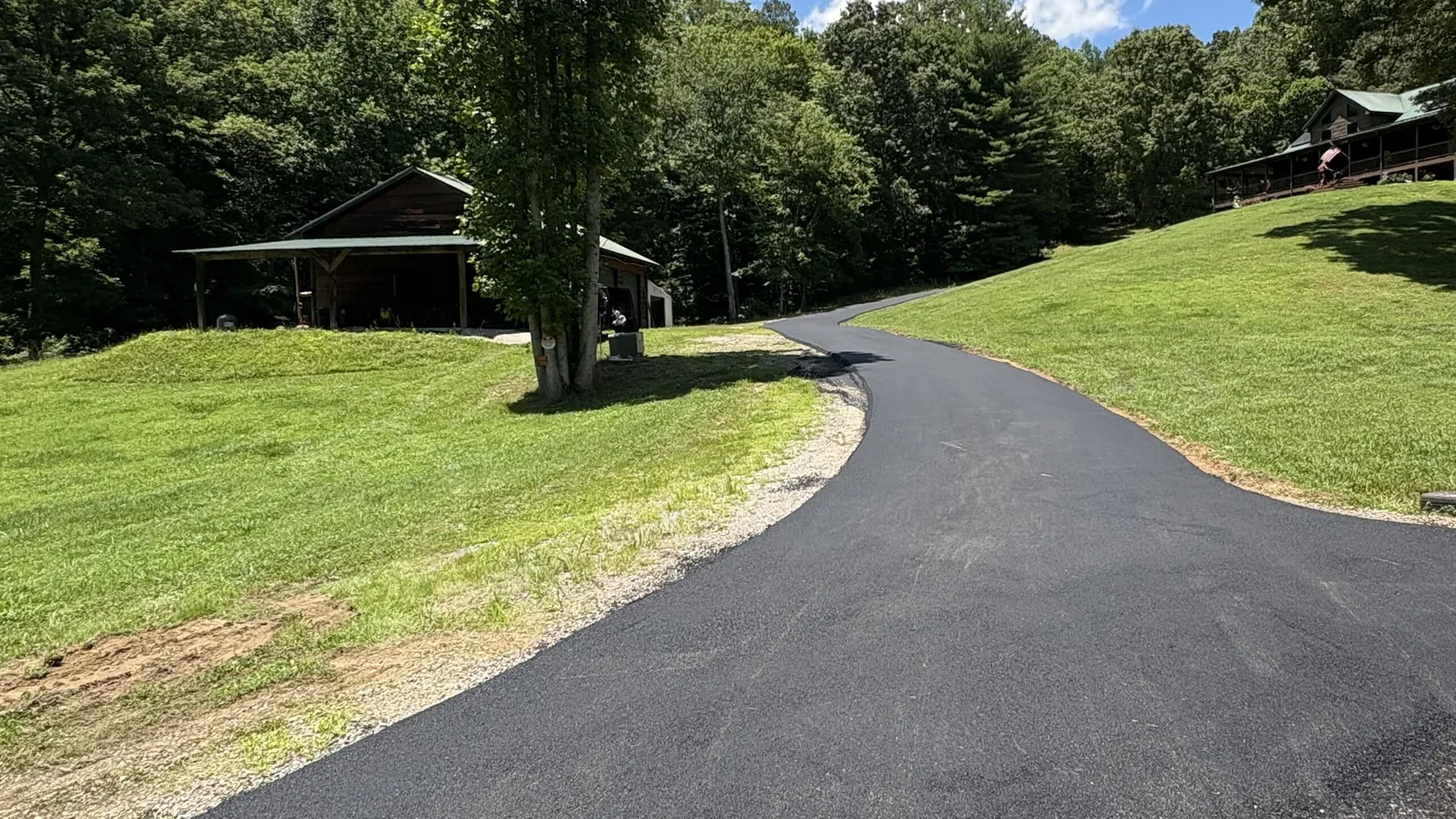
Long rural drives and steep mountain driveways are the kind of work we pave in Northwest Georgia. Plenty of them run 1,000 feet and more. At that length the square footage answers the question before looks ever come up. Grade adds to it, because a long steep drive takes more base work either way.
What about looks and resale?
Concrete wins on looks if you want choice. National cost guides list it as the customizable surface: stamped, colored, brushed, exposed aggregate. Asphalt comes one way, black, and it fades toward gray as it ages.
On resale, be careful what you read. No national remodeling study we could find puts a resale dollar figure on a driveway in either material. What the guides do show is the repair gap. Fixing a cracked slab runs $3 to $25 a square foot. An asphalt area repair runs $2 to $5. A surface in good shape shows better than a broken one.
Ready to price an asphalt driveway in Northwest Georgia?
If the drive is long, or the square footage is large, asphalt is the one to price. Want a stamped or colored finish on a short drive at the house? A concrete contractor is who to call. We will tell you which way we read your site.
We come out, look at the site and measure it. The estimate spells out the square footage, the base work and the asphalt thickness. Call or text (706) 844-2123, or read more about asphalt driveways across Northwest Georgia.